After effects: BBC accuracy failure used to promote hate

Back in March, when the UN HRC produced a report in which it established that the son of BBC Arabic journalist Jihad Masharawi had been killed as a result of a misfired terrorist rocket in November 2012, BBC Watch wrote:

“The BBC used the story of Omar Masharawi to advance the narrative of Israel as a ruthless killer of innocent children. It did so in unusually gory detail which etched the story in audiences’ minds, but without checking the facts, and with no regard whatsoever for its obligations to accuracy and impartiality. BBC reporters and editors  – including Jon Donnison, Paul Danahar and the many others who distributed the story via Twitter – rushed to spread as far and wide as possible a story they could not validate, but which fit in with their own narrative.

It is impossible to undo the extensive damage done by the BBC with this story. No apology or correction can now erase it from the internet or from the memories of the countless people who read it or heard it.”

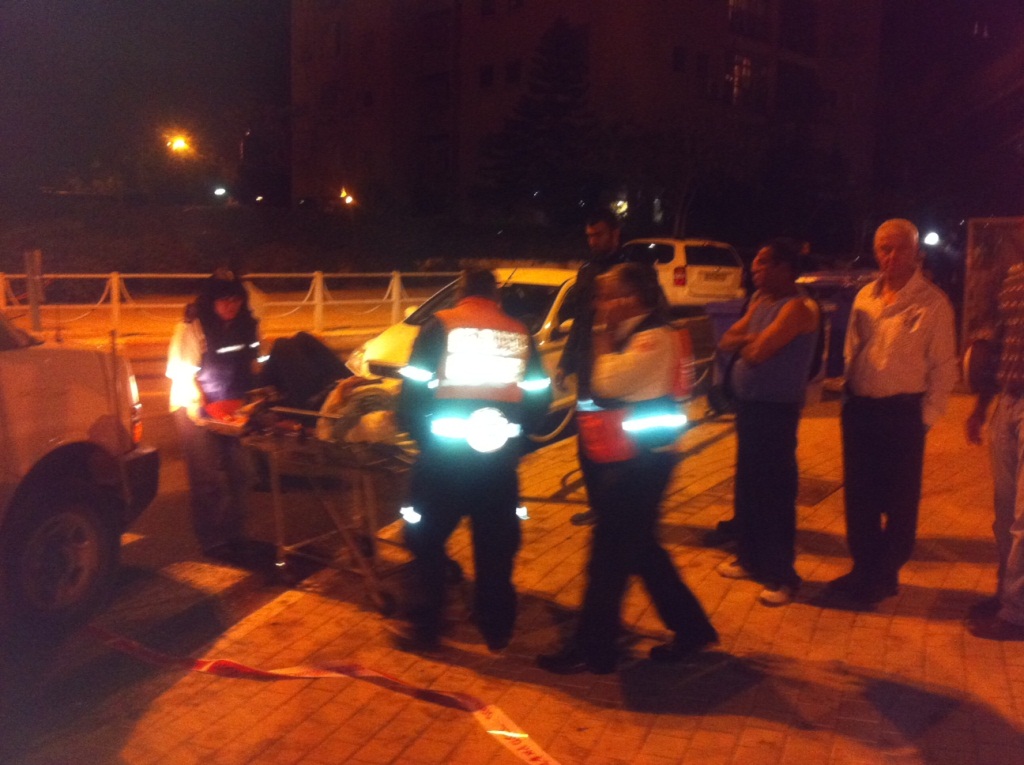
Last week the Zionist Federation in the UK held a concert to celebrate Israel’s 65th anniversary. Outside the venue, a demonstration organized by one of the Iranian regime’s mouthpieces in the West – the Islamic Human Rights Commission – was documented by British blogger Richard Millett. Below is one of Richard’s photographs of the demonstration.

IHRC at ZF event

Is the BBC responsible for the fact that Khomeinist sympathisers intent upon Israel’s destruction and the spread of hate speech against Jews use that image to promote their cause? No.

Is the BBC responsible for the fact that the picture of a father carrying his son who was killed as a result of a terrorist missile can be misrepresented as an image depicting Israeli “murder”? Yes. 

Because if BBC journalists in the Gaza Strip at the time had adhered to their own editorial guidelines on accuracy and impartiality, that story would not have been promoted as part of a preconceived narrative depicting Israelis as ‘baby killers’ and that image would not have become entrenched in the minds of the general public as a depiction of Israeli wrong-doing.

The reputation for trustworthy reporting which the BBC cultivates carries with it great responsibilities. But with regard to its Middle East reporting, the BBC often appears to be disturbingly cavalier about the potentially very serious consequences of its negligence of editorial standards on accuracy and impartiality.  

And by the way – five months on, Jon Donnison’s flawed account of Omar Masharawi’s death is still featured prominently in the Magazine section of the BBC website. 

Magazine 22 4


More missile attacks on Israel ignored by BBC

The BBC News website’s Middle East page of April 21st included a very reasonable report on the Grad missile attacks on Eilat on April 17th 2013 which originated from Sinai. 

Rocket Eilat HP 21 4

Unfortunately however, by April 21st there had been two further incidents of missile fire on Israeli communities – both from the Gaza Strip – which did not receive any coverage from the BBC.

Late in the evening on April 18th 2013, two missiles hit the Eshkol Regional Council area. No injuries were reported. Shortly after midnight on April 21st, another missile fired from the Gaza Strip hit the same region. 

These are of course not the only instances of missile fire from the Gaza Strip since the end of Operation ‘Pillar of Cloud’ which the BBC has failed to report. In fact it increasingly looks as though such attacks are only considered ‘newsworthy’ when they are followed by an Israeli response. Whether by accident or intent, the practice of ignoring the war crime of military-grade missiles being deliberately fired at civilian communities obviously fails to keep BBC audiences adequately informed and distorts audience views of events upon which the BBC does decide to report. 

BBC’s Davies presents anecdote as ‘analysis’ of legal opinion

An article entitled “Israel rules out charges over Gaza Dalou family deaths” appeared in the Middle East section of the BBC News website on April 14th 2013. The item relates to the findings of the Military Advocate General’s Corps in an investigation into an incident during ‘Operation Pillar of Cloud’ in which twelve people were killed in an IDF airstrike on November 18th 2012. 

Dalou article

The report claims that:

“More than 150 Gazans and six Israelis were killed in the brief but brutal conflict last year, named Operation Pillar of Defence by Israel.

Most of those killed were civilians, according to UN figures.”

Whilst the BBC does not specify which UN body or agency it is quoting, it seems likely that it may be basing that statement on one of several reports by UN OCHA. Alternatively, the intention could be to refer to the UN HRC report of March 2013 which actually states:

“During the crisis, 174 Palestinians were killed in Gaza. At least 168 of them were killed by Israeli military action, of whom 101 are believed to be civilians, including 33 children and 13 women.” [emphasis added]

Unfortunately – as has been the case in the past – the BBC once again does not acknowledge the complexity of differentiating between civilians and combatants in a situation of warfare waged by terrorist organisations or the fact that other reports on the subject indicate that 60% of the casualties were terrorist  combatants.

The article fails to inform readers that the civilian/combatant casualty ratio in other conflicts around the world is known to be significantly higher than those claimed in even the most pessimistic reports on ‘Operation Pillar of Cloud’. 

“The UN estimate that there has been an average three-to one ratio of civilian to combatant deaths in such conflicts worldwide. Three civilians for every combatant killed.”

The article and the side box of ‘analysis’ by Wyre Davies both make abundantly clear the BBC’s discontent with the MAG’s findings, according to which there are no grounds for a criminal inquiry into the incident. The article states:

“The BBC’s Wyre Davies says the attack on the Dalou house became a defining moment of the conflict, and challenged Israel’s assertion that it was carrying out surgical strikes on enemy targets.”

That theme is repeated in Davies’ so-called ‘analysis’.

“Irrespective of whether or not there was a legitimate “target” in the house, the thing that struck me was that, up to that point, Israel had made a huge deal about its “surgical strikes”.”

'analysis' Davies Dalou art

Well over a thousand strikes were carried out during the eight-day operation. The fact that a target was misidentified – as is regrettably inevitable in warfare, particularly in a built up area – does not “challenge” the existence of a policy of precision strikes against terrorist targets, as Davies seems to be keen to insidiously imply. Neither is there any basis for the impartiality compromising smear implied by the use of inverted commas around the word accidental in a tweet from Davies on the day this article appeared.

Davies MAG tweet

Interestingly, Davies appears to have nothing to say about the terrorists’ cynical strategy of deliberately locating military equipment and personnel among the civilian population, thus increasing the likelihood of civilian casualties.

The article goes on to say:

“Human rights groups had described the incident as a war crime and called for criminal prosecution.”

The BBC refrains from informing readers which ‘human rights groups’ it elects to quote, but it seems quite likely that one of them might be ‘Human Rights Watch’. The BBC’s lack of transparency with regard to naming the sources of such serious allegations is deplorable. It denies audiences the ability to check both the veracity of the statement quoted and the reliability of the organization making it, rendering the BBC little more than a sensationalist rumour-monger. 

Davies’ side-box of ‘analysis’ is actually more a collection of anecdote and subjective impression than that heading would suggest. BBC audiences are unlikely to expect its reporters to be capable of analysing the findings of experts on military law, but when they are proffered as exactly that, such obviously emotion-based polemics severely compromise the BBC’s reputation for accuracy and impartiality.  


Revisiting the BBC’s Iron Dome story

A few weeks ago we addressed on these pages the subject of an article by the BBC’s Defence Correspondent Jonathan Marcus concerning claims regarding the success rate of the Iron Dome made by MIT professor Ted Postol.  

Mr Marcus responded in the comments:

“I really do think this is very poor “journalism” on your part. Mr Silverstein has nothing to do with our story and presumably you include his name to excite/incite your readers. The report on Ted Postol’s work (with two other scientists cited) first ran in Ha’aretz. I saw this but waited until I had a chance to speak to Postol – who despite your rather nasty insinuations, is a highly respected scientist with a distinguished track record in this field. You will remember that he correctly questioned the performance of the initial Patriot system in the war to liberate Kuwait. His concerns about Iron Dome certainly merits an airing rather than criticism. The BBC did eventually get a response from the Israeli MoD and I updated my piece to carry this. The original story carried a blander response from them.
I fear you see plots to do down Israel where they don’t exist. I am told by technical experts that there probably are ways Israel could provide data to prove the success of its system – if indeed it was succesful – without damaging national security. Let the IDF/MoD back up their claims. It is costing rather a lot of US money, which is no problem if it works, but may be a problem if it does not.
Jonathan Marcus
BBC “

A recent article from the Jerusalem Post – written by the former Director of the Israel Missile Defence Organisation, Mr Uzi Rubin – may be of interest to readers. 

“Postol’s “analysis” of these public video clips and his underestimation of the Iron Dome’s effectiveness are meaningless and his conclusions are completely baseless.

In those clips, only the Iron Dome’s trail of smoke can be seen. The Grad rocket that it is about to intercept, however, cannot be seen.

To assess whether the Iron Dome’s missile successfully hit the Grad rocket, the trajectories of both must be observed, which is possible only through a full sky image obtained from sophisticated security sensors in which both projectiles can be observed simultaneously. This information is never released to the public since it would reveal the IDF’s discovery and tracking capabilities.”

Read the rest here

BBC resumes ‘last-first’ reporting from Gaza area – and then changes tack

Here is a headline appearing on the BBC News website’s Middle East page on the morning of April 3rd:

“Israel launches air strike on Gaza”

“Israel carries out an air strike on the Gaza Strip for the first time since an eight-day war ended in a truce last November.”

Headline ME page 3 4

The link led (see below) to an article headlined “Israel launches first air strike on Gaza since truce” – which this screenshot shows in full.

3 4 rockets Gaza

As we see, the BBC was back to its old habit of ‘last-first’ reporting, with the headlines on the Middle East home page and the article itself highlighting the last in a sequence of events and creating an impression of Israel as the initiator of violence and violator of the ceasefire. Only in the third paragraph of this seven paragraph article were readers given some sort of clue that there might have been prior incidents (not reported by the BBC at the time, incidentally) which prompted the event described in the headline.

So let’s have a look at how this article could have been written. A more accurate headline would have been phrased as follows:

Third case of rocket fire from Gaza Strip since November truce brings first Israeli response.

A more accurate strap-line would have read:

Terrorist organisations in the Gaza Strip have launched missiles at Israeli civilian targets for the third time since an eight-day war ended in a truce last November.

A more logical sequence to the body of the article would have begun by explaining to readers what happened first. For example:

Sderot kindergarden hit by a Qassam rocket fired by Gaza militants during US President Barack Obama's visiting to Israel. Photo taken April 02, 2013 (photo credit: Flash90)

Qassam rocket hit on nursery school in Sderot, discovered on April 2nd. Photo credit Flash90

On Tuesday afternoon a projectile fired from the Gaza Strip hit the Eshkol Regional Council. Two additional mortars fired around the same time fell short, landing in the Gaza Strip. Earlier the same day, a rocket was discovered in a nursery school in Sderot when it reopened after the Pessah holiday. It is thought that the rocket was one of several fired by terrorist organisations from the Gaza Strip on March 21st during President Obama’s visit to Israel. On February 26th a missile fired at the town of Ashkelon marked the first violation by rocket fire of the truce which ended the eight days of fighting between terrorist groups in the Gaza Strip and Israel in November 2012. 

Late on Tuesday night the Israeli air-force responded to the rocket fire earlier in the day by targeting two terror sites in the northern part of the Gaza Strip. This was Israel’s first response to renewed rocket fire since November 2012. The IDF Spokesperson said:

“Hamas understands that there are new rules, and the past five months have been the quietest since the [2005] disengagement. The goal is to maintain the quiet in southern Israel.”

A more accurate introduction to the Hamas statement included in the BBC report would have read:

Hamas, the Islamist terrorist organization which rules the Gaza Strip, says aircraft bombed fields near the border and no-one was injured.

Rather than implying that the missiles were fired into what readers will naturally understand to be empty “desert”, the report should have made it clear for accuracy’s sake that the intention was to target Israeli civilians, for example by writing: 

The Israeli newspaper ‘Ha’aretz’ said the air strike was near the northern Gaza town of Beit Lahiya and came after terrorists in the Gaza Strip fired mortar shells at Israeli civilian communities in the Western Negev. 

The BBC’s anodyne description of Hamas’ rise to power is also inaccurate, as its generalised reference to “building materials”. A more accurate phrasing could have read:

Since the Egyptian-mediated truce came into effect in November 2012, Israel has eased restrictions on the entry of dual-use building materials, which can be used for terror purposes, into the Gaza Strip. The restrictions were imposed after Hamas seized power there in a violent coup against the internationally recognised representatives of the Palestinian people, the Palestinian Authority, in 2007.

The article should also have been updated to include later events:

On Wednesday morning, just as children were making their way to school, two additional Qassam rockets were fired at the area of Sderot and Sha’ar HaNegev from the Gaza Strip.  

It really is not difficult to present the news in an accurate and logical sequence which is conducive to audience understanding of events. The BBC is of course not the only media organisation to contort stories by using the ‘last-first’ method of reporting, but that does not make the practice any more acceptable. 

However, it seems that perhaps at some juncture someone at the BBC realised that too.  Some thirteen hours after the original publication of the above report its headline and content were completely changed

News Sniffer

The revised headline – at the same URL- reads ”Exchange of fire between Gaza and Israel”. 

Version 2 article 3 4

The headline on the Middle East page of the BBC News website was also amended. 

Version 2 ME HP 3 4

Whilst there are still important omissions in the new article (for example the statement concerning the UN claim that four Palestinians have been killed since the end of hostilities in November does not make clear the fact that they were engaged in trying to breach the border fence), its tone is overall considerably more neutral and balanced than that of the original version of the story and that improvement is to be commended. 

Update on the BBC’s Omar Masharawi story

A member of the public has informed BBC Watch that he heard a correction made on BBC radio on March 14th 2013 regarding the BBC’s claim that an Israeli missile was responsible for the death of Omar Masharawi. He noted that:

“…the correction was very straightforwardly made, first indicating that the former blame placed on Israel was wrong, thereafter telling what had actually happened..”

Unfortunately, our correspondent could not specify the station or the programme in which he heard the announcement and so BBC Watch has been unable to trace it. 

Such an announcement would of course be a very welcome and appropriate development, but it can be of little value as long as Jon Donnison’s original report blaming Israel for the infant’s death remains ensconced on the BBC website – even taking into account the decidedly mealy-mouthed announcement now added as a footnote. 

Update Donnison Masharawi article

Magazine HP 17 3

BBC appoints Jon Donnison as ‘Shin Gimmel’ of Masharawi story

In Hebrew, the expression ‘the Shin Gimmel syndrome’ is used to describe a situation in which the public blame for an operational failure is placed upon the lowest ranking soldier – the one guarding the front gate – so that high-ranking officers can avoid having to take the responsibility and its consequences. Needless to say, the use of the ‘Shin Gimmel’ as a scapegoat is a symptom of a serious failure of leadership. 

That is precisely what the BBC has done in its belated attempt to stave off criticism of its handling of the Omar Masharawi story: it has sent Jon Donnison – the lowest ranking journalist involved in this story – to do damage control.

It has not allocated that task to Donnison’s boss at the Jerusalem Bureau, Paul Danahar, who Tweeted unverified claims that an Israeli attack had killed Omar Masharawi. Nor has the job been given to Danahar’s boss, Jeremy Bowen, whose position as Middle East Editor was created especially in order to avoid precisely such situations in the wake of previous criticisms of the BBC’s record of accuracy and impartiality when reporting on Israel. Neither was the Head of News or anyone else further up the chain of command required to provide explanations for the BBC failure. Instead, lowly Donnison was sent to take the rap.

Is it any wonder then that Donnison gives the impression of being distinctly out of his depth as he flails about trying to make passable-sounding excuses for the BBC’s failures? 

Donnison 11 3 Masharawi

Donnison’s article – entitled “UN disputes Gaza strike on BBC man’s house” – opens with the same picture of Jihad Masharawi carrying his son’s body which the BBC touted so extensively at the time. This time, however, the caption is particularly loaded. [emphasis added]

“Jehad Mashhrawi’s 11-month-old son Omar was killed in the attack on his house in Gaza”

In other words, the BBC wants to place in readers’ minds from the very beginning the idea that there was a deliberate attack on Masharawi’s house, rather than an accident. 

Donnison begins:

“The son of a BBC journalist and two relatives killed in last November’s war in Gaza may have been hit by a misfired Palestinian rocket, a UN agency says.

The UN Office of the High Commissioner for Human Rights (OHCHR) said its conclusions were based on a visit to the site a month after the attack.”

All the information in the first five paragraphs of Donnison’s article is for some reason repeated further on into the article and so we later find the following statements, which clearly intend to cast doubts upon the UN findings, not least because of the passage of time:

“UN officials visited the house four weeks after the strike.

They said they did not carry out a forensic investigation, but said their team did not think the damage was consistent with an Israeli air strike.

However, the UN said it could not “unequivocally conclude” it was a misfired Palestinian rocket.

A UN official said it was also possible the house was hit by a secondary explosion after an Israeli air strike on Palestinian weapons stores.”

The UN’s report states:

“On 14 November, a woman, her 11-month-old infant, and an 18-year-old adult in Al-Zaitoun were killed by what appeared to be a Palestinian rocket that fell short of Israel.”

A footnote adds that the UN investigated the incident itself and the UN has confirmed that the above passage in its report indeed relates to the incident at the Masharawi home. 

Donnison’s “UN official” quote above also appears in an AP report which includes further information which Donnison elected not to include in his piece:

“Matthias Behnke, head of OHCHR office for the Palestinian territories, cautioned he couldn’t “unequivocally conclude” that the death was caused by an errantly fired Palestinian rocket. He said information gathered from eyewitnesses led them to report that “it appeared to be attributable to a Palestinian rocket.”

He said Palestinian militants were firing rockets at Israel not far from the al-Masharawi home. Behnke said the area was targeted by Israeli airstrikes, but the salvo that hit the al-Masharawi home was “markedly different.”

He said there was no significant damage to the house, unusual for an Israeli strike. He said witnesses reported that a fireball struck the roof of the house, suggesting it was a part of a homemade rocket. Behnke said the type of injuries sustained by al-Masharawi family members were consistent with rocket shrapnel.”

Donnison’s efforts to pick holes in the UN findings are a deliberate attempt to distract readers from the essential point. As BBC Watch noted last November:

“Whether or not Jihad Masharawi’s house was hit by a short-falling terrorist rocket, by shrapnel from secondary explosions of Fajr 5 missiles deliberately hidden by Hamas in built-up residential areas or whether an errant IDF shell targeting those rocket launching sites and weapons storage facilities caused that accident, we may never know.”

That essential point – which Donnison does his level best to bury – is that there was no solid evidence at the time that the Masharawi house has been hit in an Israeli air-strike and indeed, several other possibilities (as now confirmed by the UN) existed. The BBC, however, not only dismissed those other possibilities – to which it had been alerted by bloggers – but exclusively and unquestioningly promoted the notion of Israel’s responsibility for the infant’s death with no factual evidence to back up that assertion. 

Donnison continues:

“At the time, human rights groups blamed the deaths on an Israeli air strike.”

He later adds:

“The family, and human rights groups, said that the house was hit in an Israeli attack.”

Ismail Haniyeh of Hamas addresses the PCHR 2006 conference

Donnison does not name the “human rights groups” he cites, but it can safely be assumed that he is referring to the Palestinian Centre for Human Rights (PCHR) which claimed on November 15th – the day after the incident – without providing any concrete evidence whatsoever, that:

“..an Israeli warplane fired a missile at a house belonging to Ali Nemer al-Masharawi in al-Zaytoun neighborhood in the east of Gaza City.  Two members of the family (a woman and a toddler) were killed: Hiba Aadel Fadel al-Masharawi, 19, and Omar Jihad al-Masharawi, 11 months.”

Far from being an objective “human rights group”, the PCHR uses the mantle of human rights in its political campaign against Israel and has a long history of unreliability. This is certainly not the first time that Jon Donnison has unquestioningly promoted information from the PCHR – apparently being unable to distinguish between a genuine human rights organization and a Hamas accessory. 

Donnison continues his attempt to bring the reader back round to believing the original BBC claims of Israeli culpability by writing:

“The Israeli military says it never denied carrying out the strike because it was not clear what had happened.”

He later adds:

“The Israeli military made no comment at the time of the incident but never denied carrying out the strike.

Privately, military officials briefed journalists that they had been targeting a militant who was in the building.”

If that were true, and if Donnison was aware of the presence of a terrorist in the building, then the next question must be why no reference was ever made to that in any of the BBC’s reports on the subject – including his own. 

Donnison continues:

“The UN says 33 other Palestinian children died in Israeli attacks during the conflict.”

Towards the end of the article, and contradicting his own use of the words “33 other”, he adds:

“The UN report concluded that at least 169 Palestinians were killed by Israeli attacks during the offensive.

It said more than 100 were civilians, including 33 children and 13 women. The report said six Israelis were killed by Palestinians attacks, including four civilians.”

As Elder of Ziyon has pointed out, the UN report – which apparently suddenly gains renewed credibility in Donnison’s eyes when it can be used against Israel – actually says:

“During the crisis, 174 Palestinians were killed in Gaza. At least 168 of them were killed by Israeli military action, of whom 101 are believed to be civilians, including 33 children and 13 women.” [emphasis added] 

As we have previously pointed out here, other reports on the casualty figures in the Gaza Strip during Operation Pillar of Cloud indicate that as many as 60% belonged to terrorist organisations. 

Further on in his article Donnison states:

“Now, though, the United Nations says the house may have been hit by a Palestinian rocket that fell short.

This is despite the fact that the Israeli military had reported no rockets being fired out of Gaza so soon after the start of the conflict.”

However, the above claim of “no rockets” is contradicted by Donnison himself in his From our own Correspondent report of November 24th:

“But at that time, so soon after the launch of Israel’s operation, Israel’s military says mortars had been launched from Gaza, but very few rockets.” [emphasis added]

As BBC Watch remarked at the time, and as the UN official quoted by AP above confirms:

“Regarding Donnison’s claim of mortars, “but very few rockets” having been fired at the time (BBC Watch has seen no such statement by the IDF, but would be delighted if Donnison could produce it), as is pointed out here, “very few rockets” does not mean no rockets.”

Under the curious subheading “Rubbish”, Donnison goes on to inform readers that:

Jihad Masharawi at his brother’s funeral

“Jehad Mashhrawi dismissed the UN findings as “rubbish”.

He said nobody from the United Nations had spoken to him, and said Palestinian militant groups would usually apologise to the family if they had been responsible.”

Apparently Donnison seems to think that this anecdote adds some kind of back-up to his story, perhaps forgetting that his own organization had (probably unwittingly) broadcast footage of Jihad Masharawi’s brother being buried in a Hamas flag. 

Donnison also states that:

“A photo of BBC video editor Jehad Mashhrawi cradling the corpse of his baby son Omar became one of the iconic images of November’s short war.”

It certainly did, but only because the BBC deliberately and energetically promoted the story far and wide, despite having no concrete evidence whatsoever to back up its claims that Israel was responsible for Omar’s death. 

The disturbing fact is that the BBC’s only response to the findings of the UN report has been to belatedly send Jon Donnison out to offer up a badly written collection of excuses and insinuations published five days later on the Middle East page of its website, whilst Donnison’s original article remains intact on that same website’s ‘Magazine’ page with no correction and no link to his article on the UN report. 

Magazine 12 3

Donnison’s cringe-worthy attempt at damage control does nothing to address the real problem underlying this story. That problem is not one of determining which type of ordnance fired by whom hit the Masharawi house, but that the BBC knowingly published and extensively promoted a story based on local anecdote for which it had absolutely no proven evidence, purely because it fit in with the political narrative accepted and promoted by the BBC. 

Fronted by Donnison, but undoubtedly with the full knowledge of his superiors, this self-destructive attempt to shift the focus of the story away from the real issue of the BBC’s complete failure to meet its own editorial guidelines on accuracy and impartiality – and to protect those further up the chain of management from the obvious conclusions of that failure – calls into question, once again,  both the sincerity of the BBC’s commitment to the values behind which it hides and the quality of the organisation’s leadership. 

A reminder of the chronology of the BBC’s Omar Masharawi story

As media outlets return to work after the weekend, the news (reported here last week) that a recent UN HRC report determined that the BBC’s much promoted version of the tragic death of Omar Masharawi on November 14th 2012 was the result of a missile fired by Palestinian terrorists rather than an Israeli air-strike – as claimed by the BBC – is gaining traction

The Washington Free Beacon has had it confirmed by a UN official that the incident described in the report indeed referred to that in which Omar Masharawi – son of the BBC employee Jihad Masharawi – was killed. 

For clarity’s sake, it is worth revisiting the chronology of the spread of the story.

On the evening of November 14th 2012, soon after the incident had happened, BBC Arabic in Gaza broke the story when it interviewed Jihad Masharawi as he held his son’s body. That film footage was used the next day in a report by Jon Donnison which appeared on BBC television news and can be seen here

On the same evening, BBC employees began Tweeting about the event, including for example the BBC’s correspondent in Washington who sent the following Tweet – retweeted by others 3,441 times:

Paul Adams twitter Masharawi

On the day after the incident – November 15th – the head of the BBC Jerusalem Bureau and chair of the Foreign Press Association, Paul Danahar, arrived in the Gaza Strip and visited the Masharawi house from where he began sending a series of Tweets which – less than 24 hours after the event and with no credible professional investigation having been carried out – unequivocally determined that the incident had been the result of an Israeli attack.

Danahar tweets Masharawi

As BBC Watch documented last November, Danahar gave permission for the photographs he had Tweeted to be used by Max Fisher at the Washington Post. Other media outlets which ran with the story on the same day – some directly citing the BBC as their source and all unquestioningly giving an Israeli attack as the cause of the infant’s death – included the Guardian, the Huffington Post , the Daily Mail, the Sun and many more. The story was of course also picked up by a plethora of anti-Israel blogs and websites. 

On November 24th 2012, the BBC ran Jon Donnison’s now infamous version of the story on its ‘From Our Own Correspondent’ programme on Radio 4, and also later on the World Service. A written version of that same report was placed on the BBC News website and at the time of writing is still there. 

Within less than two weeks, the BBC had ensured that an unverified story based purely upon evidence-free speculations by its own journalists had made its way round the entire world.

The fact that a story which in no way met the standards of accuracy laid down in the BBC’s Editorial Guidelines managed to get past the BBC’s entire system of checks and balances including the Jerusalem Bureau editor, the Middle East Editor, the Head of News, the website Editor- together with no small number of producers along the way – indicates the existence of an organisational culture which clearly renders the BBC incapable of self-regulation. 


Still no BBC accountability on Masharawi story

The BBC is still promoting its story about Omar Masharawi on its website four days after the publication of a UN HRC report which determines that the infant died as a result of the shortfall of a missile fired by terrorists in the Gaza Strip rather than due to an IDF attack in the vicinity as the BBC claimed.

Magazine 10 3

This failure by the BBC to acknowledge the problematic nature of that report even in light of the findings of the UN is particularly significant Editorial meetingin light of the fact that in other circumstances, the BBC frequently relates to UN statements as something akin to semi-sacred.

The BBC’s dragging of heels on this issue and its failure to admit to the funding public that it published and widely promoted a story without having solid evidence for the main claim upon which it was based of course casts very serious doubts upon the sincerity of the corporation’s claims of commitment to accuracy and impartiality. 

BBC’s Omar Masharawi story has rug pulled by UNHRC

The drop down menu of the ‘From our own correspondent’ section on the ‘magazine’ page of the BBC News website looked like this on March 7th 2013:

FOOC Masharawi magazine 7 3

Yes – over three months after Operation Pillar of Cloud, the BBC is still promoting Jon Donnison’s story about the son of the BBC employee in Gaza who the BBC very energetically insisted had been killed in an Israeli air-strike. 

As readers may remember, BBC Watch pointed out at the time that there were terrorist rocket launching sites in the Zaitoun neighbourhood of Gaza City in which the Masharawi home was situated and that the BBC’s automatic assumption that Omar Masharawi’s death was the result of an Israeli attack was not founded upon any solid evidence.

In his report Donnison stated:

“Despite the evidence pointing towards an Israeli air strike, some bloggers have suggested it might have been a misfired Hamas rocket.

But at that time, so soon after the launch of Israel’s operation, the Israeli military says mortars had been launched from Gaza but very few rockets.

Mortar fire would not cause the fireball that appears to have engulfed Jehad’s house.

Other bloggers have said that the damage to Jehad’s home was not consistent with powerful Israeli attacks but the BBC visited other bombsites this week with very similar fire damage, where Israel acknowledged carrying out what it called “surgical strikes”.

As at Jehad’s home, there was very little structural damage but the victims were brought out with massive and fatal burns. Most likely is that Omar died in the one of the more than 20 bombings across Gaza that the Israeli military says made up its initial wave of attacks.”

Despite the lack of evidence, the BBC continued (and still continues, as can be seen above) to promote this story very heavily indeed and of course it was picked up and propagated by other members of the mainstream media – as well as numerous anti-Israel websites – as cast-iron evidence of Israeli wrongdoing,  bearing the hallmark of BBC accuracy and impartiality. 

On March 6th 2013 the UN HRC issued an advance version of its report on the November 2012 hostilities and blogger Elder of Ziyon bothered to read the whole thing. The report states on page 14 that a UN investigation found that:

“On 14 November, a woman, her 11-month-old infant, and an 18-year-old adult in Al-Zaitoun were killed by what appeared to be a Palestinian rocket that fell short of Israel.” [emphasis added]

A footnote adds that the UN investigated the incident itself.

Omar Masharawi was the only 11 month-old infant killed on November 14th in the Zaitoun neighbourhood (although the woman killed at the same time was not in fact his mother as the UN report states, but his father’s brother’s wife; Hiba). 

The BBC used the story of Omar Masharawi to advance the narrative of Israel as a ruthless killer of innocent children. It did so in unusually gory detail which etched the story in audiences’ minds, but without checking the facts, and with no regard whatsoever for its obligations to accuracy and impartiality. BBC reporters and editors  – including Jon Donnison, Paul Danahar and the many others who distributed the story via Twitter – rushed to spread as far and wide as possible a story they could not validate, but which fit in with their own narrative.

It is impossible to undo the extensive damage done by the BBC with this story. No apology or correction can now erase it from the internet or from the memories of the countless people who read it or heard it. Nevertheless, the people responsible for the fact that the unverified story was allowed to run – and that it was deliberately given such exceptionally extensive coverage – must be held accountable for their failure to even try to uphold the standards to which the BBC professes to adhere. 

Any other outcome will make a mockery of the supposed BBC commitment to accuracy and impartiality and will further erode the BBC’s already bruised reputation.