BBC’s Davies describes new Golan fence as ‘controversial’

The ‘Features & Analysis’ section of the Middle East page of the BBC News website included an item by the BBC Jerusalem Bureau’s Wyre Davies on May 12th entitled “Israel prepares for the worst as tensions over Syria grow“.

In that piece, readers once again see the Iranian-backed terrorist organization Hizballah described in cartoonish terms as Israel’s “arch-enemy in southern Lebanon” and once again the writer manages to produce an entire article based around the subject of Israeli responses to weapons transfers to Hizballah via Syria without explaining the all-important underlying UN Security Council resolution 1701

Davies’ main theme in this feature is that Israel is preparing itself for another round of conflict with Hizballah – an assertion which will not be news to anyone with even a basic familiarity with the Middle East.

“It is obvious as well, that not just the municipality of Haifa but the Israeli government and the higher echelons of the army are getting ready for the possibility if not the probability of another conflict in the north.”

However, Davies appears to have swallowed the same dubious claims regarding the Iron Dome missile defence system as promoted by his colleagues Kevin Connolly and Jonathan Marcus in recent weeks.

“Driving out of Haifa, newly installed batteries of the much vaunted Iron Dome anti-missile defence system are visible in fields to the north of the city.

After the system was successfully used in last year’s Gaza conflict, it should provide added security for Haifa and other northern towns in the event of another conflict, even though there is still a debate about how effective the system – developed in Israel and financed by the United States – actually is.”

Later on in the article comes this rather curious statement:

“Although all of the intelligence and military assessments concur that the greatest immediate threat to Israel still comes from the north and Hezbollah, in recent weeks and months there has also been a great deal of concern and attention focused on the eastern frontier.”

That analysis suggests that Davies has not entirely grasped the fact that whilst Hizballah’s traditional stomping ground is indeed southern Lebanon (to the north of Israel), its record of activity abroad and its involvement in the Syrian civil war indicate that it is by no means confined to that geographical location. The Lebanese website Naharnet reported earlier in the week that Hizballah has been involved in the recent fierce fighting in the Dara’a area in southern Syria – close to the borders with both Jordan and Israel – and other reports suggest that the terror organisation’s presence in that region has, with Iranian prompting, received Bashar Assad’s blessing. 

Meanwhile, on the morning of May 15th, mortars from Syria landed in the area of Mount Hermon in the northern Golan Heights, with the fire later being claimed by an Islamist group operating in Syria. On the same day a New Zealander serving with UNTSO was abducted from an observation post in the Golan, apparently together with two othersbut released after a few hours. In southern Lebanon a UNIFIL post was overrun with three soldiers also briefly kidnapped and equipment and ammunition stolen. None of the above incidents has so far been reported by the BBC. (Also unreported was missile fire on the same day on Israel’s southern area of Eshkol.) 

The repeated incidents of abductions of UN personnel in the Golan Heights have already had a detrimental effect upon peace-keeping activities along that border (one imagines much to the delight – if not intent – of the assorted Islamist groups located in the area) and an alleged recent EU statement suggests that the same could apply to the Lebanese – Israeli frontier.  Ironically, during a visit to Lebanon on May 13th, the UN Under Secretary-General for Peacekeeping saw fit to whitewash the long-standing failure of his organisation to implement UN SC 1701 which has led to the current situation in which Hizballah is able to threaten regional stability on several fronts. 

“In his remarks, Mr. Ladsous commended Israel and Lebanon for their continued commitment to the cessation of hostilities and the implementation of Security Council resolution 1701, which ended the 2006 war between Israel and the Lebanese group Hizbollah, and calls for respect for the Blue Line, the disarming of all militias in Lebanon, and an end to arms smuggling in the area.”

Towards the end of Davies’ article we find another bizarre statement: 

“Israel’s response to the fighting and upheaval on the Syrian side of the plateau has been spectacular if controversial.

A massive new 3m (10ft) high fence has been built in almost no time along the entire length of the de-facto border and Israel’s military presence has been visibly stepped up in the region.”

What exactly Davies thinks is “spectacular” or “controversial” about replacing a forty year-old rusty fence with a new one in light of the appearance of armed Al Qaeda-affiliated groups on its other side is – to this writer at least – something of a mystery.

And for as long as the BBC continues with its practice of selective reporting of events on Israel’s northern and eastern borders – as well as those on its southern one with the Gaza Strip – BBC audiences will also remain mystified with regard to the dynamics at work in cooking up the next round of conflict – from whichever direction it may come.


BBC promotes Assad propaganda in Syria reports

The BBC’s reporting on the weekend’s unfolding events in Syria is in top gear. On May 4th an article entitled “Israeli warplanes launch air strike inside Syria” – including a filmed report by Wyre Davies which was also broadcast on BBC television news – appeared on the Middle East page of the BBC News website. 

That frequently amended article relating to the events of May 2nd/3rd was based on a CNN report which in turn was based on claims made by anonymous US officials. According to the BBC article, a consignment of weapons destined for Hizballah was the target of Israeli air-strikes. The article states: [emphasis added]

“While Israel rarely comments on specific operations, it has repeatedly said it would act if it felt Syrian weapons, conventional or chemical, were being transferred to militant groups in the region, especially Hezbollah, says the BBC’s Wyre Davies in Jerusalem.”

Actually, it is probably safe to assume that any decision to send Israeli pilots on a mission to neutralize weapons consignments in enemy territory is based on considerably more than a ‘feeling’.

On May 5th coverage expanded to include the events of the night of May 4th/5th under the headline “Damascus ‘hit by Israeli strikes’”.

Syria 5 5

The coverage included a rolling article entitled “Damascus military facilities ‘hit by Israel rockets’” in which readers were informed that:

“The BBC’s Jim Muir in Beirut says Israel’s intervention is a very dangerous development.

He says Israel will not want to be seen as being involved in the conflict, but Syria’s state media is hammering the message that the rebels are working hand in glove with Israel.”

Apparently, any Israeli action is to be considered much more of a “dangerous development” than the possibility of long-range missiles or chemical weapons falling into the hands of a terrorist organisation. And of course that particular “message” from the Syrian authorities is nothing new – and neither is its uncritical repetition by the BBC.

That passage was later replaced by the following one:

“The BBC’s Yolande Knell in Jerusalem says the latest developments are a significant escalation in Israel’s involvement in the conflict.

She says Israel has already responded to fears of retaliation by locating two batteries of its Iron Dome missile defence system near Haifa, close to the Lebanese border.”

Haifa is, of course, some 43 kilometers from the Lebanese border. 

The latest version of that article includes a side box of analysis by Jim Muir in which he – like Yolande Knell – seems to be incapable of distinguishing between an act of self-defence and “involvement” in the Syrian civil war.

“Two air strikes in 48 hours does indeed start to look perilously like the involvement in Syria’s internal crisis the Israelis have always said they want to avoid, especially when they are visibly taking out military targets on the very edge of Damascus.” […]

“Israel has said that its only concern is to prevent advanced weapons being handed over to Hezbollah. Objectively it would be hard to see Israel’s interest in helping trigger an uncontrolled collapse of the regime, leaving the field open to rebel groups among which Islamist radicals currently make the running.”

Muir appears to be incapable of grasping the fact that beyond the issue of weapons being transferred by the Syrian regime to its allies Hizballah – a situation which would prompt further deterioration of the security situation in Lebanon and Syria as well as Israel – the very real possibility of weapons falling into the hands of those “Islamist radicals” also carries with it the potential for further destabilization of the region as a whole. 

analysis Muir

The BBC’s coverage also includes an article by its Defence Correspondent Jonathan Marcus entitled “Israeli air strikes: A warning to Syria’s Assad“. Whilst all in all a balanced and informative article, in common with the BBC coverage of the strike on a weapons convoy last January, it fails to inform readers of the all-important context of UN Security Council Resolution 1701 and the international community’s utter failure to either disband Hizballah or prevent it from rearming after the 2006 war which has enabled the current situation to come about. 

Regrettably, the BBC also saw fit to resurrect a deeply flawed article from 2011 under the link titled “Are Hezbollah terrorists?” for inclusion in its coverage of these events. 

But the worst was yet to come. A later BBC report ran the headline “Israeli strikes on Syria ‘co-ordinated with terrorists“, yet again uncritically repeating baseless statements put out by the Assad regime.

“The Syrian foreign ministry statement said three military sites had been hit – a research centre at Jamraya, a paragliding airport in the al-Dimas area of Damascus and a site in Maysaloun.

“The flagrant Israeli attack on armed forces sites in Syria underlines the co-ordination between ‘Israel’, terrorist groups and… the al-Nusra Front,” the statement said, referring to al-Qaeda militants fighting with the rebels. […]

The statement added: “This leaves no room for doubt Israel is the beneficiary, the mover and sometime the executor of the terrorist acts which Syria is witnessing and which target it as a state and people directly or through its tools inside.” “

'coordinated with terrorists'


Official BBC Tweets also promoted the same propaganda.

bbc world tweet

As one Tweeter succinctly put it:

tweet Maher

And no – the use of inverted commas in that headline does not excuse the unquestioned, context-free promotion of propaganda from a regime which has already killed over 70,000 of its own people. 

BBC’s Davies suggests ulterior motives for IDF Sarin report

On April 23rd 2013 the BBC News website published a report entitled “Syria has used chemical weapons, Israeli military says“. The article relates to comments made by Brigadier General Itai Brun – head of the Research Division of the IDF’s Military Intelligence Branch – at a security conference in Tel Aviv.  

The original article was later updated to include subsequent remarks made by the US Secretary of State.

 ”Mr Kerry said he had called the Israeli prime minister seeking confirmation chemical weapons had been used by the Syrian regime, adding that Mr Netanyahu “was not in a position to confirm that… I do not know yet what the facts are.” “

The BBC Jerusalem Bureau’s Wyre Davies gave free rein to his own speculations regarding Secretary Kerry’s comments on Twitter.

Davies tweets Syria Sarin

Of course Brigadier General Brun’s observations came just over a week after Britain and France had expressed similar concerns whilst saying that they believe that they have credible evidence of Assad’s use of chemical weapons.

Curiously, however, Wyre Davies apparently did not feel the need at the time to speculate to his Twitter followers that the British and French statements might indicate that the United States was “being bounced into an uncomfortable position” by those countries. 

And then, two days later, the US administration stated that in fact it has intelligence reports of its own regarding the use of chemical weapons in Syria. 

Davies tweets Syria Sarin 25 4

Quite how Wyre Davies managed to reach the conclusion from Brigadier General Brun’s observations and the subsequent remarks made by Secretary Kerry that Israel wants “action against Syria” is a mystery. But it is surely a sad indication of a journalist’s priorities when weaving an imaginary intrigue trumps human concern for those on the receiving end of attacks with chemical weapons. 

BBC’s Wyre Davies Tweeting for illegal building

Here are two consecutive Tweets sent by the BBC Jerusalem Bureau’s Wyre Davies on April 18th 2013 to his 14,775 followers. (Read from the bottom up).

Davies Beit Jala tweets

Davies apparently did not bother to fact check the details of the incident before sending his Tweets, seemingly making do with whatever he was told by his sources. But BBC Watch did check out the details of story with COGAT.

The site of the Al Mahrour (also spelt Al Makhrour) restaurant is situated in Area C where, according to the Oslo accords signed willingly by the representatives of the Palestinian people, Israel has administrative and security control.

The restaurant was constructed without planning permission or the appropriate building permits and hence was the subject of a demolition order issued in 2005 and carried out in May 2012. The restaurant was then rebuilt – also illegally without the necessary planning permission or building permits. The restaurant’s owner/constructor was given the opportunity to appear before the planning committee of the Civil Administration. A second demolition order was issued and that was carried out on April 18th 2013. The electricity line to which Davies refers was also illegally connected.

One presumes that back in his native Wales, Wyre Davies would not raise so much as an eyebrow if his local authority issued a demolition order for a food and drink establishment intended to host members of the public which made no attempt to comply with planning regulations on issues such as fire safety, sanitation, hygiene, structure safety, drainage, waste disposal, electricity supply and so forth. In fact, he might be quite relieved to see such an obvious disregard for public safety being addressed by those responsible. 

Quite why Davies should consider the safety of potential visitors to the Al Mahrour restaurant any less important is a mystery. But what is clear is that Davies’ Tweets breach BBC Editorial Guidelines on both accuracy and impartiality, as well as BBC News social media guidance and the specific guidelines on the use of microblogs.

“Those involved in editorial or production areas must take particular care to ensure that they do not undermine the integrity or impartiality of the BBC or its output on their blogs or microblogs. For example those involved in News and Current Affairs or factual programming should not advocate a particular position on high profile controversial subjects relevant to their areas.”

Wyre Davies has obviously lost the ability to report from this part of the world without the injection of his own personal views and prejudices – thus severely compromising his employer’s reputation for impartiality.

BBC’s Davies presents anecdote as ‘analysis’ of legal opinion

An article entitled “Israel rules out charges over Gaza Dalou family deaths” appeared in the Middle East section of the BBC News website on April 14th 2013. The item relates to the findings of the Military Advocate General’s Corps in an investigation into an incident during ‘Operation Pillar of Cloud’ in which twelve people were killed in an IDF airstrike on November 18th 2012. 

Dalou article

The report claims that:

“More than 150 Gazans and six Israelis were killed in the brief but brutal conflict last year, named Operation Pillar of Defence by Israel.

Most of those killed were civilians, according to UN figures.”

Whilst the BBC does not specify which UN body or agency it is quoting, it seems likely that it may be basing that statement on one of several reports by UN OCHA. Alternatively, the intention could be to refer to the UN HRC report of March 2013 which actually states:

“During the crisis, 174 Palestinians were killed in Gaza. At least 168 of them were killed by Israeli military action, of whom 101 are believed to be civilians, including 33 children and 13 women.” [emphasis added]

Unfortunately – as has been the case in the past – the BBC once again does not acknowledge the complexity of differentiating between civilians and combatants in a situation of warfare waged by terrorist organisations or the fact that other reports on the subject indicate that 60% of the casualties were terrorist  combatants.

The article fails to inform readers that the civilian/combatant casualty ratio in other conflicts around the world is known to be significantly higher than those claimed in even the most pessimistic reports on ‘Operation Pillar of Cloud’. 

“The UN estimate that there has been an average three-to one ratio of civilian to combatant deaths in such conflicts worldwide. Three civilians for every combatant killed.”

The article and the side box of ‘analysis’ by Wyre Davies both make abundantly clear the BBC’s discontent with the MAG’s findings, according to which there are no grounds for a criminal inquiry into the incident. The article states:

“The BBC’s Wyre Davies says the attack on the Dalou house became a defining moment of the conflict, and challenged Israel’s assertion that it was carrying out surgical strikes on enemy targets.”

That theme is repeated in Davies’ so-called ‘analysis’.

“Irrespective of whether or not there was a legitimate “target” in the house, the thing that struck me was that, up to that point, Israel had made a huge deal about its “surgical strikes”.”

'analysis' Davies Dalou art

Well over a thousand strikes were carried out during the eight-day operation. The fact that a target was misidentified – as is regrettably inevitable in warfare, particularly in a built up area – does not “challenge” the existence of a policy of precision strikes against terrorist targets, as Davies seems to be keen to insidiously imply. Neither is there any basis for the impartiality compromising smear implied by the use of inverted commas around the word accidental in a tweet from Davies on the day this article appeared.

Davies MAG tweet

Interestingly, Davies appears to have nothing to say about the terrorists’ cynical strategy of deliberately locating military equipment and personnel among the civilian population, thus increasing the likelihood of civilian casualties.

The article goes on to say:

“Human rights groups had described the incident as a war crime and called for criminal prosecution.”

The BBC refrains from informing readers which ‘human rights groups’ it elects to quote, but it seems quite likely that one of them might be ‘Human Rights Watch’. The BBC’s lack of transparency with regard to naming the sources of such serious allegations is deplorable. It denies audiences the ability to check both the veracity of the statement quoted and the reliability of the organization making it, rendering the BBC little more than a sensationalist rumour-monger. 

Davies’ side-box of ‘analysis’ is actually more a collection of anecdote and subjective impression than that heading would suggest. BBC audiences are unlikely to expect its reporters to be capable of analysing the findings of experts on military law, but when they are proffered as exactly that, such obviously emotion-based polemics severely compromise the BBC’s reputation for accuracy and impartiality.  


One-dimensional BBC reports on Fayyad resignation

In the past few days the BBC News website’s Middle East page has run two items about the resignation of Salam Fayyad from the post of prime minister of the Palestinian Authority. One is a news report from April 13th titled “Palestinian Prime Minister Salam Fayyad resigns” and the other is an April 16th article by Jon Donnison entitled “What next as Palestinian PM Salam Fayyad resigns?” placed under the “Features & Analysis” banner. 

Fayyad article

Both articles rightly take note of the tensions between Fayyad and PA President Mahmoud Abbas – together with his Fatah faction – which preceded the former’s resignation, although they do little to explain just how far back those tensions actually go to their readers.

The April 13th report states:

“His resignation is the climax of long-running and increasingly bitter dispute between the prime minister and the president.

They have been at odds over economic policy since Finance Minister Nabil Kassis quit last month, and rumours were rife that Mr Fayyad would step down.

Mr Fayyad accepted Mr Kassis’s resignation, but he was subsequently overruled by Mr Abbas, challenging his authority.”

Jon Donnison writes:

“Those close to him say Mr Fayyad has become increasingly frustrated with Fatah officials and others within the government trying to undermine him.

There are said to be disagreements with Mr Abbas over the handling of the struggling Palestinian economy.”

Both reports fail to explain adequately to readers how Salam Fayyad came to be involved in Palestinian politics in the first place and how that history colours his relationship with Fatah and the Palestinian street. 

“Since its establishment in 1994 the Palestinian National Authority has been financed by donor contributions and its financial affairs overseen by the IMF [International Monetary Fund] and the World Bank. Despite tutorage from international financial institutions, some $900 million of revenues were diverted by Chairman Arafat to non–PA bank accounts between the years 1995 to 2000, very little of which was recovered. Concerns raised by the international community at various Ad Hoc Liaison Committee conferences were ignored by the PA until the IMF Resident Representative Dr. Salam Fayyad initiated a plan of reform in 1999. However, the proposed reforms were not fully implemented and a second wave of reform had to be initiated in 2002 when Salam Fayyad was appointed as Minister of Finance to the PA.”

In other words, Fayyad was the international community’s way of trying to deal with PA corruption: a fact which has not contributed to his popularity at home, as Khaled Abu Toameh explains here.

“Abbas and Fatah leaders see the US-educated Fayyad, who was appointed prime minister in 2007 at the request of the US and EU countries, as a threat to their control over the Palestinian Authority in general and its finances in particular.

Were it not for US and EU intervention, Abbas and Fatah would have removed Fayyad from his job several years ago.

Each time Abbas considered sacking Fayyad, US and EU government officials stepped in to warn that such a move would seriously affect foreign aid to the Palestinian Authority.”

The disagreement between Fayyad and Abbas (now in the ninth year of his four-year term of office) over the resignation of the former Finance Minister Kassis (also spelt Qassis) has much deeper roots than the BBC report suggests.

“The Fatah leaders are yearning for the era of Yasser Arafat, when they and others were able to lay their hands on millions of dollars earmarked for helping Palestinians.

In a bid to regain some form of control over the Palestinian Authority’s finances, last year Abbas exerted heavy pressure on Fayyad to appoint [Abbas loyalist] Nabil Qassis as finance minister.

Until then, Fayyad had held the position of finance minister in addition to the premiership.

Earlier this year, Fayyad, in a surprise move, announced that he has accepted the resignation of Qassis without providing further details.

Shortly afterwards, Abbas issued a statement announcing that he has “rejected” the resignation of the finance minister.

Fayyad has since refused to comply with Abbas’s demand and reinstate Qassis.”

Both reports also relate to the subject of the potential effects of Fayyad’s resignation on peace negotiations. The April 13th report states:

“A BBC correspondent says Mr Fayyad’s resignation is a major blow for US efforts to restart the long-stalled peace process with Israel. […]

The BBC’s Wyre Davies in Jerusalem says Mr Fayyad was seen as a key person in US attempts to restart peace negotiations with Israel.

President Abbas may now struggle to replace him with someone who can match his level of international credibility, our correspondent says.”

Jon Donnison writes:

“If he is to go, it would be a serious blow to the United States, which has recently re-launched efforts to try to breathe life into a comatose Israeli-Palestinian peace process.

Mr Fayyad, a US-educated economist and a former official at the International Monetary Fund, is widely perceived as being a moderate whom America and the international community could work with.”

Neither of the articles, however, provides the context necessary for readers to understand what Fayyad’s resignation really exposes as far as the commitment to the peace process inside the PA and on the Palestinian street is concerned. 

For several years the international would-be midwives of a Palestinian state have focused their efforts on institution building, in accordance with Salam Fayyad’s vision of bottom up state-building as set out in his Reform and Development Plan

“It was in the aftermath of the implosion of the PA following the Hamas coup in Gaza that by then, Prime Minister (albeit unelected) Salam Fayyad presented his Reform and Development Plan 2008–2010 to the Paris Conference and received international support for his initiative. World Bank monitoring of the success in implementing this plan forms the basis of recent assessments regarding the PA’s readiness for statehood.

The Reform and Development Plan focuses on issues of economy, finance and infrastructure of government and social services. Many of the areas cited for attention and improvement are exactly the same ones as those highlighted in numerous previous reports and reform plans such as government transparency, financial accountability, local government reform, the development of the private sector, the reduction of the number of employees in the public sector, pension reform, the rule of law and judicial reform. As in the past, the implementation of the Reform and Development plan hinges entirely upon continued foreign financing of the PA.”

However, the internationally approved focus on institution building as a basis for a Palestinian state did nothing to tackle the subject of the preparation of Palestinian society for peace with its neighbours – ignoring, for example, the subject of PA approved incitement against Israel, the official glorification of terrorism and the payment of salaries to convicted terrorists. 

Not only was it always plainly ridiculous to base peace plans on the presence of one man considered by Western donors to be trustworthy, but the failure – including by Fayyad himself – to address incitement against Israel and the status of terrorism within Palestinian society as obstacles to a peace agreement ultimately contributed to Fayyad’s unpopularity on the Palestinian street. 

“Fayyad has no grassroots support or political power bases among Palestinians.

He does not have a strong political party that would be able to compete with Fatah.

Nor does he have his own militia or political backing, especially in the villages and refugee camps of the West Bank.

In the 2006 parliamentary election, Fayyad, who was graduated from the University of Texas at Austin, ran at the head of an independent list called Third Way. He won only two seats in the Palestinian Legislative Council.

Most Palestinians did not vote for Fayyad because he had never played any active role in the fight against Israel. For Palestinians, graduating from an Israeli prison is more important than going to any university in the world.

The Palestinians’ problem with Fayyad is that he did not sit even one day in an Israeli prison.

Had Fayyad killed a Jew or sent one of his sons to throw stones at an Israeli vehicle, he would have earned the respect and support of a large number of Palestinians. In short, Palestinians do not consider Fayyad a hero despite his hard efforts to build state institutions and a fine economy.”

Whilst BBC journalists debate whether Fayyad will stay or go and what effect that might have on the peace process, they – like many of Fayyad’s supporters in the West – apparently fail to realize that peace is about a lot more than one particular personality. Given the BBC’s default placing of blame for the failure of the peace process on a variety of exclusively Israeli causes (be they ‘settlements’ or the perceived disinterest of the Israeli government), it is hardly surprising  that it fails to provide its audiences with comprehensive explanations of the long-existing fault lines within the PA which Fayyad’s resignation exposes. That leaves BBC audiences with a one-dimensional view of the peace process and the reasons for its failure to bear fruit. 

In which the BBC ignores prejudice in Israeli football

Readers will surely not have forgotten the bout of BBC binge-reporting a couple of months ago on the subject of a group of racist fans of the Beitar Jerusalem football club. At the time, no fewer than four reports on the same subject appeared on the BBC News website in less than a week.

On March 23rd the Kfar Kama Sports Club youth football team – renowned for its mixed squads of players from Jewish, Arab and Circassian backgrounds and its promotion of tolerance through sport – travelled to an away match in the Druze village of Majdal Shams in the north Golan Heights. The game, however, did not take place

“Dozens of residents of the Majdal Shams village, located in the Golan near the Syrian border, stormed a local soccer field Saturday, demanding that the Youth Division game played on the field – between the Kfar Kama team and the local team – be immediately discontinued.

The reason, the rioters insisted, was that the soccer field belongs to Syrian territory, on which Israeli league teams are not allowed to play.” […]

” “We did not expect such a traumatic incident to happen to the kids,” said Kfar Kama coach Nir Adin, adding that the Majdal Shams team usually hosts games in the Arab town of Nahf in the Galilee and that Saturday was the first time his team played in Majdal Shams.

According to Adin, “After the riot started we didn’t want things to turn violent so we hurried to take the kids down to the locker room. Dozens of people stormed the field and drove us away.”

The Majdal Shams team was also taken by surprise.

Coach Nadib Ayoub said: “This is a disaster for us – especially for the kids. This was supposed to be a historic game for us, hosting a game for the first time. Nothing could prepare us for this scenario. This was very unfortunate.” “

A week later, the troublemakers were back.

Revealingly, this instance of prejudice in football did not warrant four articles – or indeed any articles at all – from the BBC’s correspondents in Jerusalem.  

Of course one does not expect the BBC to provide comprehensive coverage of all sporting events in Israel: for that we have the local media. But if – as it did in the case of Beitar Jerusalem – the BBC is going to cynically employ the actions of football fans as a hook upon which to hang obsessive coverage deliberately designed to create the impression in the minds of its audiences that Israel is a country riddled with racism, then it must acknowledge that it cannot selectively limit that coverage to the actions of Israeli Jews alone without having its impartiality called into doubt. 

BBC’s Davies crafts a narrative by omission

Among the reams of BBC coverage of the recent visit by Barack Obama to Israel was this article written by Wyre Davies of the BBC Jerusalem Bureau on March 20th 2013. 

Davies article 20 3

Readers will no doubt notice Davies’ decidedly bizarre assertions concerning Israeli democracy:

“A visit by the “leader of the free world” is always a big occasion, nowhere more so than Israel which increasingly sees itself as an isolated beacon of democracy in a troubled region.

That view is, of course, frequently challenged overseas and within Israel itself, but rarely in the United States.”

But it is the next part of Davies’ report which provides an excellent example of how a specific narrative can be crafted through omission.

“Three years ago, Israel’s Prime Minister Benjamin Netanyahu openly lectured President Obama about the realities of Middle Eastern politics, in his own office.

The president’s aides looked on ashen-faced and Mr Obama listened impassively as the Israeli leader tore into his assertion that a future Palestinian state should be based on the pre-1967 ceasefire lines.”

Davies is in fact referring back almost two years – to May 20th 2011 – the first day of a five-day visit by Israel’s prime minister to the United States. But what he neglects to mention is that on the previous day, as Netanyahu was about to embark on the journey to Washington, Obama delivered a speech of his own in which he stated that a future Palestinian state should be based on what he termed “the 1967 lines” – or as they are more accurately described; the 1949 Armistice agreement lines. 

“The United States believes that negotiations should result in two states, with permanent Palestinian borders with Israel, Jordan, and Egypt, and permanent Israeli borders with Palestine. The borders of Israel and Palestine should be based on the 1967 lines with mutually agreed swaps, so that secure and recognized borders are established for both states. ”

For Israelis – only too aware of the indefensible nature of those armistice lines and the fact that just eighteen years after they were drawn, Israel yet again faced the threat of annihilation from its neighbours – Obama’s declaration was seen as an American adoption of the Palestinian viewpoint, a hindrance to negotiations and back-tracking on the commitments made by Obama’s predecessor in 2004. 

“As part of a final peace settlement, Israel must have secure and recognized borders, which should emerge from negotiations between the parties in accordance with UNSC Resolutions 242 and 338. In light of new realities on the ground, including already existing major Israeli populations centers, it is unrealistic to expect that the outcome of final status negotiations will be a full and complete return to the armistice lines of 1949, and all previous efforts to negotiate a two-state solution have reached the same conclusion. It is realistic to expect that any final status agreement will only be achieved on the basis of mutually agreed changes that reflect these realities.”

Hence, the day after what some saw a public ambush, Netanyahu stated during his visit to the White House:

“I think for there to be peace, the Palestinians will have to accept some basic realities.  The first is that while Israel is prepared to make generous compromises for peace, it cannot go back to the 1967 lines — because these lines are indefensible; because they don’t take into account certain changes that have taken place on the ground, demographic changes that have taken place over the last 44 years.

Remember that, before 1967, Israel was all of nine miles wide.  It was half the width of the Washington Beltway.  And these were not the boundaries of peace; they were the boundaries of repeated wars, because the attack on Israel was so attractive.

So we can’t go back to those indefensible lines, and we’re going to have to have a long-term military presence along the Jordan.  I discussed this with the President and I think that we understand that Israel has certain security requirements that will have to come into place in any deal that we make.”

Wyre Davies, however, neglects to inform his readers of the context to Netanyahu’s words, instead reducing them to the superficial category of a spontaneous ‘lecture’ “in his own office”. Of course for readers to take something from Davies’ jaundiced account beyond the impression of Israeli rudeness (and worse) which he so deftly weaves, that context is vital. The failure to provide it can only be viewed as an attempt to shape a specific political narrative. 

The politics of BBC approved terminology on Israel’s security fence

A series of Tweets sent by the BBC Jerusalem Bureau’s Wyre Davies on the last day of the Obama visit to Israel provides an opportunity to take a closer look at a specific case of BBC approved terminology. 

Davies 'separation barrier' tweets

Davies’ use of the phrase “separation barrier” complies with the BBC’s “Key Terms” – established for use by its journalists covering subjects relating to “the Israeli-Palestinian conflict” in the wake of the Balen Report, but only partially made public in 2006 at the recommendation of the Thomas Report. 

The rationale for the use of the term “separation barrier” is described in the “Key Terms” as follows:

“BARRIER

BBC journalists should try to avoid using terminology favoured by one side or another in any dispute.

The BBC uses the terms “barrier”, “separation barrier” or “West Bank barrier” as acceptable generic descriptions to avoid the political connotations of “security fence” (preferred by the Israeli government) or “apartheid wall” (preferred by the Palestinians).

The United Nations also uses the term “barrier”.

Of course, a reporter standing in front of a concrete section of the barrier might choose to say “this wall” or use a more exact description in the light of what he or she is looking at.” [emphasis added]

Obviously, both the avoidance of use of the term “security fence” and the employment in its place of the phrase “separation barrier” have their own political connotations – which apparently escape the BBC.

The BBC’s decision to eschew the term “security fence” means that it consistently and deliberately conceals from its audiences the real reasons for the construction of that fence. Concurrently, its use of the phrase “separation barrier” implies that the fence was built for the purpose of dividing one thing from another and in no way reflects the fact that it actually came into being in order to protect Israeli civilians from Palestinian terror.

Things become even more clumsy when BBC reporters try to add ‘context’ to their use of the phrase “separation barrier”, as this recent example shows: 

“The motorcade’s route took Mr Obama through Israel’s controversial West Bank barrier, Israeli security sources said. Israel says the barrier is the only way to defend against militant attacks, but Palestinians view the structure as the prelude to the annexation of occupied land.” [emphasis added]

Here we see that not only is the security fence turned into a “barrier” in accordance with BBC guidelines, but it is also presented as “controversial”. It takes a special kind of perversity to describe a structure which has proven its ability as one of several (and not “the only” as stated above) counter-terrorism methods used to save lives as “controversial”, of course, but it is that same factor which apparently allows the BBC to ignore the hard evidence of the security fence’s efficacy, instead employing the much-used phrase “Israel says” in order to cast doubt upon those facts.

“A comparison of the above data shows a decrease of slightly more than 90% in the number of attacks: from an average of 26 attacks a year before the fence, to three attacks after erection of the anti-terrorist fence. This means a decrease of more than 70% in the number of Israelis murdered: from an average of 103 slain per year before the fence to 28 after erection of the fence. Similarly, this means a drop of more than 85% in the number of wounded: from an average of 688 a year before the fence to 83 wounded per year after it was built. ”

Equally perverse are the standard BBC description of suicide bombers and other terrorists as “militants” and the attempt to juxtapose the proven evidence of the security fence’s role in saving lives with the politically motivated fantasy narrative of various Palestinian and anti-Israeli factions as though they were of equal factual value. In this case, the BBC’s boiler-plate attempt at impartiality just makes it look ridiculous. 

Interestingly, barriers constructed in order to thwart terrorism on British soil are allotted very different terminology by the BBC.

Peace walls 1

Peace walls 2 

The BBC’s choice of and adherence to the inaccurate term “separation barrier” completely airbrushes out of the picture the horrific Palestinian terrorism of the Second Intifada. That in turn distorts historic facts and results in diminished audience understanding of the conflict. The fact that the authors of the “Key Terms” (who include Middle East reporting ‘gate-keepers’ Jeremy Bowen and Malcolm Balen) actually state in writing that they consider the title of a structure designed to save human lives to have “political connotations” reveals volumes as regards their own adoption of a specific political narrative and raises severe doubts as to their capability for impartiality. 

A wave of propaganda: BBC revisits the 2010 flotilla

The BBC News website’s Middle East page on March 23rd 2013 was headed by no fewer than six items pertaining to what was described as an “Israeli apology for flotilla deaths”. 

flotilla articles 23 3

Those items include a written article entitled “Israel PM apologies for Gaza flotilla deaths” which also includes video footage and a filmed report under the same title by Wyre Davies which appeared on BBC television news. Curiously, the footage in both those reports comes with a disclaimer

flotilla art 2

Other items include a written report by Kevin Connolly entitled “Mavi Marmara: US extracts last-minute Israeli apology”, a written article titled “Obama ends Middle East trip with visit to Petra ruins” which also features video footage by Yolande Knell and Q&A piece going under the dramatic headline “Q&A: Israeli deadly raid on aid flotilla”. 

All of these reports contain a plethora of basic inaccuracies on the one hand and distinguish themselves through deliberate omissions of crucial information on the other. 

The widespread assertion made in the website heading, article titles and in the reports themselves that Israel apologized “for flotilla deaths” is both inaccurate and superficial. As Professor Barry Rubin points out here, this event did not come out of the blue and as explained on PM Netanyahu’s Facebook page, the apology was for “any mistakes that might have led to the loss of life or injury”. 

Netanyahu FB flotilla

Hence, the claim made by Wyre Davies in his filmed report that “Israel apologized for its role in the deaths of the nine activists” is inaccurate, as is the claim made by Yolande Knell that:

“He [Obama] got the Israeli Prime Minister on the phone apologizing to the Turkish Prime Minister for that deadly military raid on a Turkish ship heading to Gaza with activists on board three years ago.”

The fact that such inaccurate portrayals by Davies and Knell found their way into BBC television news reports is rendered even more egregious when one notes that the wording in the strap line of the main article appearing on the BBC News website indicates that the BBC is actually well aware of the real facts:

“Israel’s prime minister has apologised to Turkey for “any errors that could have led to loss of life” during the 2010 commando raid on an aid flotilla that tried to breach the Gaza blockade.” [emphasis added] 

Another serious inaccuracy which appears across the board in these reports is the portrayal of the Mavi Maramra as a ship transporting “aid” to Gaza and the description of its passengers as “activists”. Wyre Davies says in his filmed report:

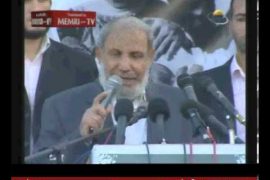
Sheikh Mohammed al-Hazimi, a member of the Yemeni Parliament and of Al-Islah, aboard the Mavi Marmara

“….nine Turkish activists on a boat called the Mavi Marmara taking aid to Gaza. That boat was boarded by Israeli marines and nine of the activists were killed.”

In this article the BBC claims that:

“Nine people were killed on board the Turkish aid ship, Mavi Marmara, when it was boarded by Israeli commandos while trying to transport aid supplies to Gaza in May 2010 in spite of an Israeli naval blockade.”

The Q&A article claims that:

“It [the flotilla] wanted to deliver aid to Gaza, breaking an Israeli and Egyptian blockade on the territory. The ships were carrying 10,000 tonnes of goods, including school supplies, building materials and two large electricity generators. The activists also said they wanted to make the point that, in their view, the blockade was illegal under international law.”

The blockade is not of course “illegal under international law”, as the UN’s Palmer Report made perfectly clear.

“The fundamental principle of the freedom of navigation on the high seas is subject to only certain limited exceptions under international law. Israel faces a real threat to its security from militant groups in Gaza. The naval blockade was imposed as a legitimate security measure in order to prevent weapons from entering Gaza by sea and its implementation complied with the requirements of international law.”

The fact that three years on, the BBC is still promoting that myth – albeit whilst apparently thinking it has itself covered by ostensibly quoting someone else – and that it does not make it clear that the “activists” have no legitimate basis for their “views”, represents a clear breach of BBC Editorial Guidelines on impartiality and accuracy.

As for the BBC’s various claims pertaining to “aid”, the Mavi Marmara was of course one of seven vessels which made up the flotilla, but the only one on board which any violence took place. The flotilla’s organisers were offered in advance by Israel the opportunity to dock at Ashdod port, have any cargo inspected for weapons and illegal goods and then have it transported into Gaza. Any legitimate aid organization would have taken advantage of that offer, but the flotilla organisers refused it. 

Further, beyond the personal effects of some 600 passengers aboard the Mavi Marmara – clearly a number far in excess of that required by any legitimate aid mission – no humanitarian goods were found on that specific ship or on two of the other vessels comprising the flotilla. 

The “aid” which was carried by the other four ships included expired medicines, second-hand used clothing and other goods – many of which were damaged due to improper packaging. The total amount of “aid” was later packed into 34 trucks for transport into Gaza (although Hamas refused to accept it initially). During the same week, 484 trucks of genuine aid passed into the Gaza Strip via the crossings on the border with Israel. 

As for the “activists” (as the BBC euphemistically terms them), we can get a good idea of the kind of received wisdom which lies behind the use of that phrasing by looking at the section under the sub-heading “Who organised it?” of the Q&A article.

Bulent Yidirim (IHH) and Ismail Haniyeh, January 2010

“A group called The Free Gaza Movement, an umbrella organisation for activists from numerous countries, and a Turkish group called the Foundation for Human Rights and Freedoms and Humanitarian Aid (IHH).

The Israeli government says the IHH is closely linked to the Palestinian Islamist movement Hamas, which it views as a terrorist group, and is a member of another organisation, the Union of the Good, which supports suicide bombings. However, the Turkish government regards the IHH as a legitimate charity, and had urged Israel to let the flotilla through.”

The BBC’s anodyne description of the ‘Free Gaza Movement’ is nothing less than scandalous. It completely ignores the FGM’s connections to the International Solidarity Movement and the close links of both those groups to the terrorist organisation Hamas. It fails to mention the FGM’s dismal record of support for terror and antisemitism and its documented strategy of organizing flotillas as a PR exercise, as well as the involvement of many of its members and supporters in other anti-Israel campaigns. 

Members of the ‘Free Gaza Movement’ receive medals from Ismail Haniyeh in Gaza in 2008

No better is the BBC’s whitewashing of the IHH. As we see above, according to the BBC it is “the Israeli government” – and it alone – which “says” that the IHH is “closely linked” to Hamas. It is also the Israeli government which “views” Hamas as a “terrorist group”.

This warped version of reality ignores the fact that many other countries define Hamas as a terrorist organization besides Israel. It also downplays the nature of the ‘Union of Good’ – of which the IHH is a member – by describing it vaguely as an organization “which supports suicide bombings”. The Muslim Brotherhood’s Union of Good – headed by the antisemitic preacher Yusuf Qaradawi – which came into existence at the beginning of the Second Intifada as a way of raising and channelling funds to enable terror attacks by Hamas and its affiliates against Israeli civilians. It is designated by the US government as well as Israel

The BBC’s simplistic making do with the statement that the IHH is a “legitimate charity” in the eyes of the current Turkish government  does not even attempt to explain to readers the close ties between the two and the extent of the support provided by the Turkish government in the organization of the flotilla.  

All these BBC reports totally ignore the clear evidence of incitement to and preparations for violence on board the Mavi Marmara well  in advance of any meeting with the IDF, as shown for example in an Al Jazeera report aired two days before the incident. 

Almost three years after the Mavi Marmara incident, the BBC’s reporting on the subject reads like a press release of which the ‘Free Gaza Movement’ itself would be proud. The blatant omission of crucial information concerning the flotilla’s organisers and participants, as well as of the circumstances of the incident itself, can only be regarded as an attempt to dictate a very specific, dumbed-down narrative about the event to BBC audiences in order to shape perceptions. That clearly compromises the BBC’s obligations to both accuracy and impartiality – as well as insulting audiences’ intelligence.